
Converting a physical disc collection into a permanent offline media library requires strict decryption. Optical media is vulnerable to read errors from surface damage, pushing users toward digital archiving. Building a local media server or preparing files for mobile viewing demands a straightforward method to bypass AACS encryption and region codes, while strictly maintaining the original 4K UHD video bitrates, Dolby Atmos, and DTS-HD audio tracks.
AnyMP4 Blu-ray Ripper handles this exact digitization process by converting massive 50GB ISO files and BDMV folders into formats like uncompressed MKV or highly compressed H.265 HEVC MP4. Instead of chaining multiple open-source tools together, users can process high-definition movies directly. A dedicated hardware-accelerated blu-ray ripper utilizes active GPU processing to cut down encoding times, delivering a 1:1 digital backup ready for immediate playback on Plex, smart TVs, or portable devices.
💡 Related Resource: Direct playback of encrypted physical media, ISO files, and heavy BDMV folders without digital conversion requires a dedicated local media handler. Review the decoding capabilities of AnyMP4 Blu-ray Player to manage these uncompressed formats natively, currently available with an official 50% license reduction.
DVD vs. Blu-ray Ripping: What Changed?
Extracting data from standard definition DVDs involves basic MPEG-2 decoding and managing relatively small 4.7GB file sizes. Transitioning to high-definition formats completely alters the extraction architecture. A single 1080p or 4K UHD physical disc holds between 25GB and 100GB of dense data, locked behind advanced AACS encryption and multi-layered BD+ protection. Standard extraction methods fail against these complex security protocols, resulting in immediate read errors or completely corrupted M2TS output files.
Processing massive high-bitrate video streams demands significant computational power, often pushing standard CPUs to their thermal limits. Executing a successful physical media backup now requires precise decoding methodologies to manage HEVC compression efficiently. AnyMP4 Blu-ray Ripper bypasses these heavy architectural hurdles by utilizing active GPU acceleration to process massive BDMV folders and ISO images directly. This specific extraction methodology ensures the raw optical media data is converted rapidly without triggering system bottlenecks.
- Advanced AACS Decryption Protocols: Legacy CSS encryption is obsolete. Current 4K UHD archiving requires bypassing dynamic disc keys and strict region restrictions to access the core multimedia structure.
- Massive Storage and HEVC Encoding: A lossless MKV extraction retains the exact 50GB footprint of the original disc. This necessitates high-capacity NAS environments or aggressive H.265 video compression to manage local drive limits.
- Spatial Audio Metadata Preservation: Basic stereo tracks are replaced by complex surround formats. Precise digital extraction is mandatory to keep Dolby Atmos and DTS-HD Master Audio profiles perfectly synced with the main video feed.
Is It Legal to Rip Blu-rays You Own?
Navigating copyright laws regarding physical media archiving often confuses home theater owners. Legally purchasing a retail movie grants the right to view the content, but digitizing it requires bypassing AACS encryption protocols. While specific regulations restrict breaking copy protection, creating a digital backup strictly for a local NAS or a private Plex server usually falls into a widely accepted grey area known as format shifting. This concept applies exclusively to optical discs you actively own and keep in your physical possession.
The legal boundary becomes absolute when distribution is involved. Extracting data from rental discs, library copies, or borrowed movies to build a local server constitutes direct copyright infringement. Uploading lossless MKV files to public networks, sharing compressed MP4 formats online, or selling digitized copies are severe violations. AnyMP4 Blu-ray Ripper aligns with these legal boundaries by officially prohibiting the extraction of rented media or any processing intended for commercial distribution.
How to Rip a Blu-ray to MP4 or MKV
Converting high-capacity optical discs into universally compatible digital formats requires precise handling of encrypted video streams. AnyMP4 Blu-ray Ripper simplifies this procedure by offering a direct workflow to create uncompressed MKV backups or highly compressed MP4 files. Utilizing native GPU hardware acceleration ensures that processing massive data structures occurs rapidly without overwhelming local hardware capabilities.
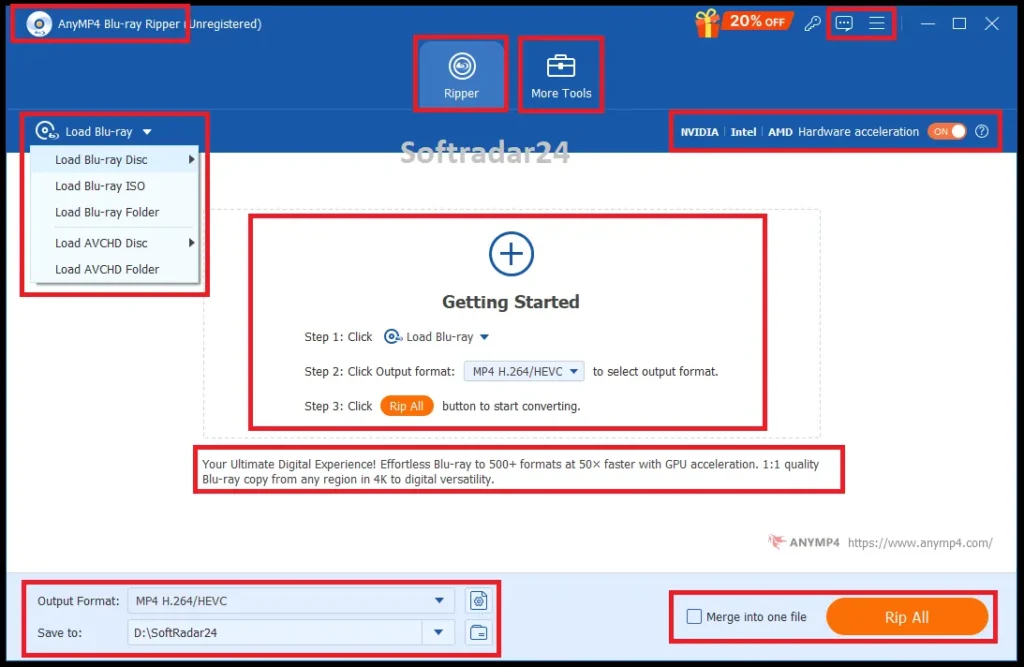
Step 1: Prepare the Optical Drive: Connect an internal SATA or external USB 3.0 Blu-ray drive to your computer and insert the target disc. For processing 4K UHD media, utilize a LibreDrive-compatible optical drive to directly bypass hardware-level revocation blocks.
Step 2: Load the Media Source: Open AnyMP4 Blu-ray Ripper and navigate to the Ripper tab. Click the central plus icon to read the physical disc, or use the Load dropdown menu to import local BDMV folders and ISO image files.
Step 3: Select the Video Titles: The system will automatically analyze the complex disc structure. Choose the Full Title List option to reveal every included movie file, bonus feature, and hidden track, then hit OK to display them on the main dashboard.
Step 4: Configure the Output Format: Click the Video tab under the Rip All to section. Search for your preferred container, such as 4K MKV for lossless archiving or 4K MP4 with the H.265 codec for efficient compression. Enabling H.265/HEVC hardware acceleration at this stage drastically cuts encoding times.
Step 5: Define Destination and Execute: Navigate to the Save to path at the bottom and designate a local hard drive or NAS folder with sufficient storage capacity. Finally, click the Rip All button to finalize the digital conversion.
Technical Specifications of AnyMP4 Blu-ray Ripper
Evaluating a digital conversion architecture requires looking directly at hardware optimization, decryption limits, and format compatibility. The data below outlines the exact technical parameters of AnyMP4 Blu-ray Ripper, detailing its capacity to handle 4K UHD video streams, bypass AACS encryption, and utilize GPU hardware acceleration. These metrics provide a clear overview of the performance levels to expect during the optical media digitization process.
| Core Category | Comprehensive Feature Details |
|---|---|
| Media Output & Quality | Supports over 500 digital formats (MP4, MKV, MOV, FLV) with uncompressed 4K UHD and 1080p HD capabilities. Transforms standard 2D feeds into 3D, while managing custom external subtitles and multiple simultaneous audio streams. |
| Decryption & Performance | Actively bypasses AACS, BD+ protection, region codes, and advanced DRM protocols with stable physical media recognition. Utilizes GPU hardware acceleration to achieve up to 30X faster encoding speeds. |
| Editing & AI Utilities | Includes timeline adjustments (crop, rotate, custom filters, text watermarking) and an integrated AI video enhancer for 4K upscaling and noise reduction. Features a native media player, GIF creator, file compressor, and metadata editor. |
| Compatibility | Offers native playback profiles for 500+ hardware configurations, including smart TVs and VR headsets. Compatible with Windows and macOS via a straightforward dashboard. |
AnyMP4 Blu-ray Ripper Discount Code
Purchasing a valid license for AnyMP4 Blu-ray Ripper is straightforward when dealing directly with the official developer. Buyers currently receive a strict 50% price reduction on both the one-year subscription and the permanent lifetime plan. There is no need to search for external promotional strings, as the correct discount is automatically applied at the official checkout page.


50% OFF – AnyMP4 Blu-ray Ripper for Windows
AnyMP4 Blu-ray Ripper for Windows (Lifetime)
Secure permanent access to bypass AACS protection and digitize 4K UHD discs. Create lossless MKV or MP4 backups without subscription fees.
AnyMP4 Blu-ray Ripper for Windows (1-Year)
Process heavy BDMV folders and ISO files directly. Utilize GPU acceleration to backup physical media quickly for a full year.
50% OFF – AnyMP4 Blu-ray Ripper for Mac
AnyMP4 Blu-ray Ripper for Mac (Lifetime)
Convert high-capacity optical media into HEVC formats directly on macOS. Get an unrestricted lifetime license for local archiving.
AnyMP4 Blu-ray Ripper for Mac (1-Year)
Manage strict region codes and retain DTS-HD audio tracks seamlessly. Enjoy 12 months of high-speed media conversion on your Mac.
Frequently Asked Questions
Can AnyMP4 Blu-ray Ripper bypass region codes on imported discs?
Bypassing strict geographic limitations is a core capability. AnyMP4 Blu-ray Ripper actively removes Region A, B, and C restrictions, alongside standard AACS and BD+ encryption protocols, allowing users to digitize foreign optical media without encountering playback errors.
Does AnyMP4 Blu-ray Ripper require a specific optical drive to process 4K UHD movies?
Standard optical readers lack the hardware capacity to read ultra-high-definition physical media. Extracting 4K UHD data requires pairing AnyMP4 Blu-ray Ripper with a LibreDrive-compatible optical drive, which prevents hardware-level revocation blocks and allows direct reading of the encrypted M2TS video streams.
How much local storage is needed when converting a movie with AnyMP4 Blu-ray Ripper?
Storage footprints depend entirely on the selected output container. Executing a lossless MKV extraction retains the exact 25GB to 50GB data structure of the original retail disc, whereas applying H.265 HEVC video compression reduces the final digital file to approximately 5GB to 15GB while preserving optimal visual clarity.
How long does AnyMP4 Blu-ray Ripper take to digitize a standard two-hour physical disc?
Relying strictly on standard CPU processing often requires over an hour to encode dense video data. Activating the integrated GPU hardware acceleration shifts the heavy encoding workload to the graphics card (supporting NVIDIA, AMD, and Intel architectures), shrinking the total conversion timeline for a two-hour movie to roughly eight minutes.