Windows 11 strictly mandates a UEFI boot mode paired with a GUID Partition Table (GPT) disk structure. However, resolving specific hardware incompatibilities, conducting legacy system testing, or preparing a drive for older operating systems frequently requires reverting the disk architecture back to the Master Boot Record (MBR) format. Attempting this structural downgrade through native Windows command-line utilities presents a catastrophic barrier: the built-in DiskPart interface strictly requires a complete disk wipe before initiating any conversion.
Bypassing this destructive formatting process requires specialized disk management protocols. AOMEI Partition Assistant Professional directly addresses this limitation by reconstructing the partition architecture at the binary level. The Partition Assistant Pro system executes a seamless transition from GPT to MBR while strictly preserving every existing file, partition layout, and system record, completely eliminating the need for data backups or a clean operating system installation.
How to Convert GPT to MBR Without Formatting (Step-by-Step)
Transforming a primary system drive from a GUID Partition Table to a Master Boot Record requires specific execution depending on the current state of the computer. AOMEI Partition Assistant Professional handles this structural change either directly within an active desktop environment or through an independent recovery interface.
Converting an Active Windows Drive
When the computer boots normally but requires a disk downgrade for compatibility testing, the conversion executes directly through the main dashboard.
Step 1: Initiating the Conversion Module: Locating the primary system drive (usually Disk 0) on the main interface and right-clicking the disk profile reveals the advanced context menu. Selecting the “Convert to MBR” option triggers the initial confirmation prompt.
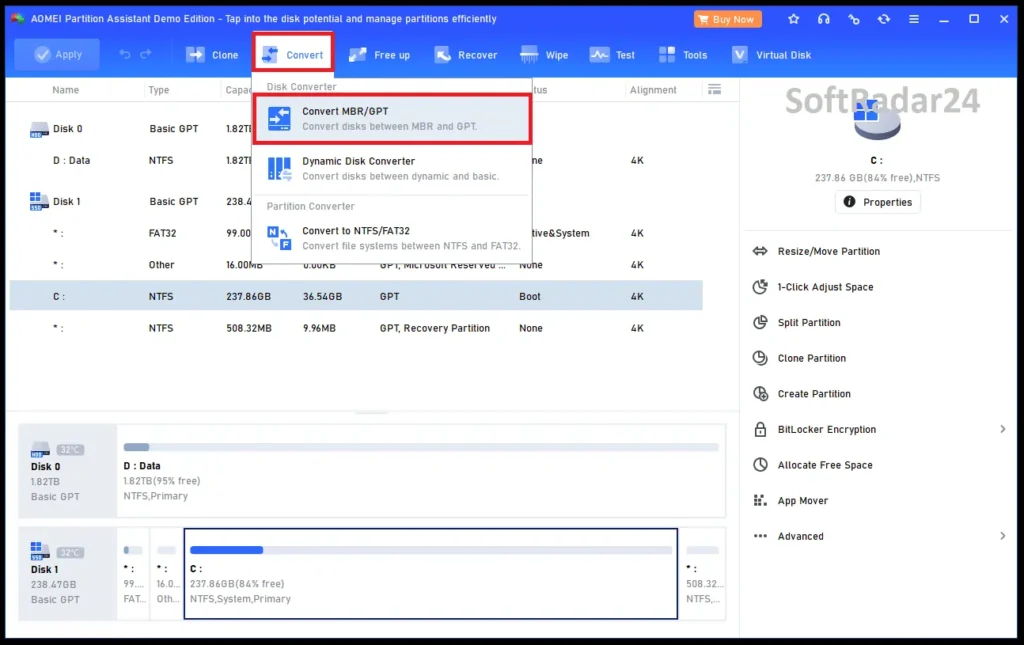
Step 2: Executing the Structural Transition: Clicking the “Apply” button located on the top navigation bar queues the operation. Because the target disk contains active system files, the system automatically schedules a secure restart into PreOS mode. This isolated environment reconstructs the partition table at the binary level without formatting the drive.
Step 3: Motherboard Reconfiguration: Immediately following a successful conversion, the computer requires a manual reboot into the motherboard BIOS/UEFI settings. Switching the primary boot mode from “UEFI” to “Legacy/CSM” is mandatory. Failing to adjust this hardware setting prevents the newly converted MBR disk from loading the operating system.
Converting During Windows Installation Errors
Attempting to install an operating system frequently results in the “selected disk is of the GPT partition style” error, halting the installation entirely. Resolving this requires modifying the drive without an active operating system.
Step 1: Generating Rescue Media: Accessing a separate, functioning computer allows AOMEI Partition Assistant Pro to create an independent recovery drive. Utilizing the “Make Bootable Media” function burns the entire partition management interface directly onto a standard USB flash drive.
Step 2: Bypassing the Installation Error: Inserting the newly created USB drive into the problematic computer and adjusting the BIOS boot priority loads the complete management dashboard into the memory. Administrators can then execute the exact GPT to MBR conversion protocol outlined in Scenario A, safely removing the installation barrier without erasing existing partitions.
Frequently Asked Questions (FAQ)
Does AOMEI Partition Assistant erase data during GPT to MBR conversion?
Performing a conversion through AOMEI Partition Assistant Professional preserves all existing data and partition structures. The underlying technology modifies the partition table at the binary level, eliminating the need for destructive formatting or manual data backups.
Can a Windows 11 system boot after AOMEI Partition Assistant Pro converts the drive to MBR?
Windows 11 strictly requires a UEFI environment and a GPT structure for standard boot operations. Utilizing AOMEI Partition Assistant Professional to convert the primary system drive to MBR will make the disk incompatible with the Windows 11 boot sequence, which is why this procedure is generally reserved for legacy hardware compatibility or secondary storage adjustments.
How does AOMEI Partition Assistant Pro handle conversions if the operating system fails to load?
Creating a “Make Bootable Media” USB drive through AOMEI Partition Assistant Professional allows for disk modifications outside the standard operating system environment. Booting the machine from this rescue media provides full access to the AOMEI Partition Assistant Professional dashboard to resolve installation errors or partition mismatches.
Does AOMEI Partition Assistant Pro support MBR conversion for high-capacity NVMe SSDs?
AOMEI Partition Assistant Professional can convert any physical disk to the Master Boot Record format, regardless of the hardware interface. However, the legacy MBR architecture restricts total capacity to 2TB, meaning that any storage space exceeding this limit remains unallocated after the AOMEI Partition Assistant Professional conversion process.
Is bidirectional disk conversion possible within the AOMEI Partition Assistant Pro interface?
The administrative dashboard of AOMEI Partition Assistant Professional allows for seamless switching between MBR and GPT architectures in both directions. This flexibility ensures that a drive can safely return to its original partition style using the same secure AOMEI Partition Assistant Professional protocols that maintain data integrity.
Does the free edition of AOMEI Partition Assistant convert Windows 11 system disks?
Converting a physical disk that contains an active operating system or critical boot records requires the advanced conversion protocols available in AOMEI Partition Assistant Professional. The standard free version limits structural modifications exclusively to secondary, non-system data drives, making AOMEI Partition Assistant Professional the necessary choice for boot drive adjustments.